
In addition to retrofitting fire stations, historic buildings and landmarks to meet earthquake safety standards, and offering tax breaks to homeowners who do the same, Berkeley has teamed up with its well known university, the University of California, Berkeley (Cal), to train students in disaster response and equip them with the supplies that are necessary to help.
"If you look at the greater good - especially if you live in a community that is subject to fires, earthquakes, tornadoes, hurricanes, tsunamis - you have to have a plan in advance," said Gil Dong, deputy fire chief of the Berkeley Fire Department. Hurricane Katrina was instructive, he said, because it showed that if people don't take the time to prepare, a lot of them will be left waiting, which could lead to more injuries and deaths.
The No. 1 benefit of the student responder program is that more people will be there to help when an earthquake occurs.
"For some people who don't know how to take care of themselves in disaster situations, there will be people who know what to do," said Bradley Kerr, a junior at Cal who is majoring in environmental science and is the Interfraternity Council (IFC) vice president of risk management. "For the majority of the populace that doesn't take the time and wouldn't even consider that an earthquake might happen until it actually is happening, there's already something in place to help protect them and keep them safe."
Berkeley's preparation now includes Cal students who live in fraternities, sororities and co-ops. They are being equipped with emergency training and supplies.
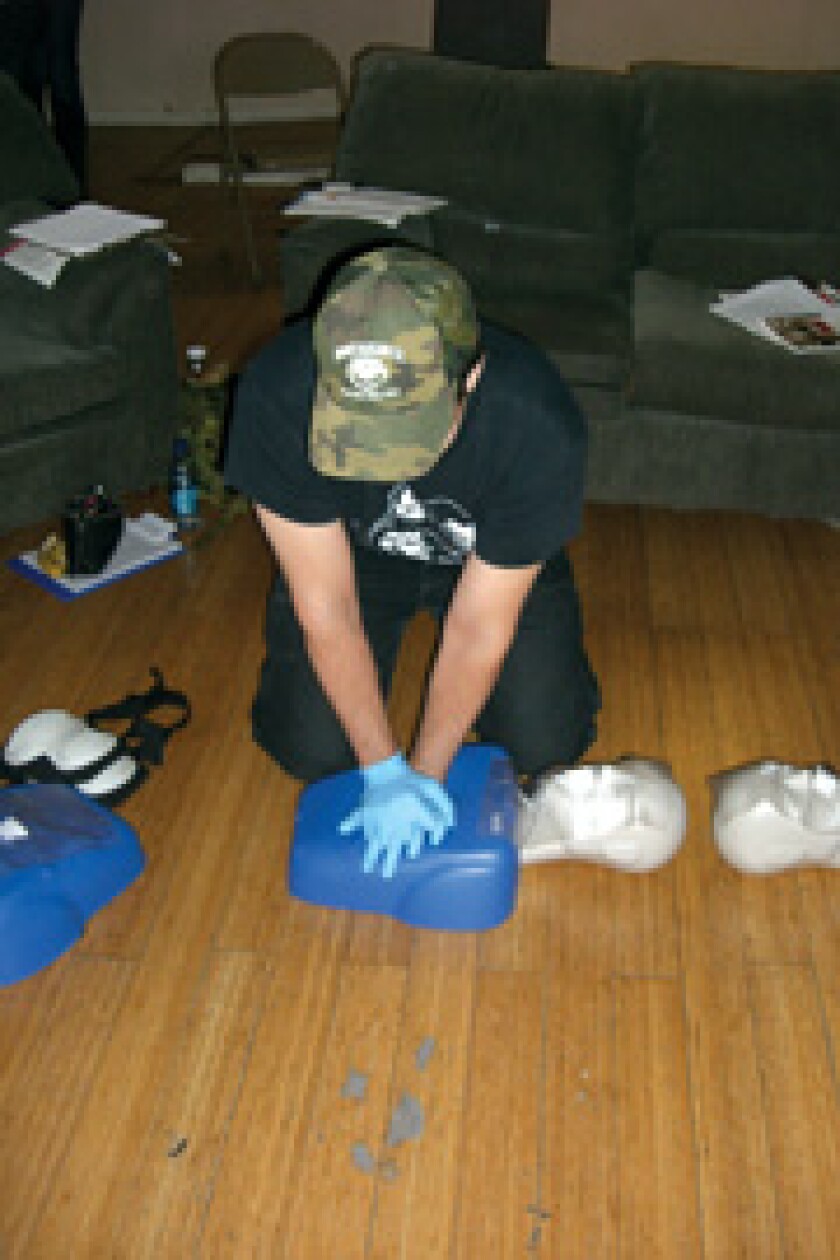
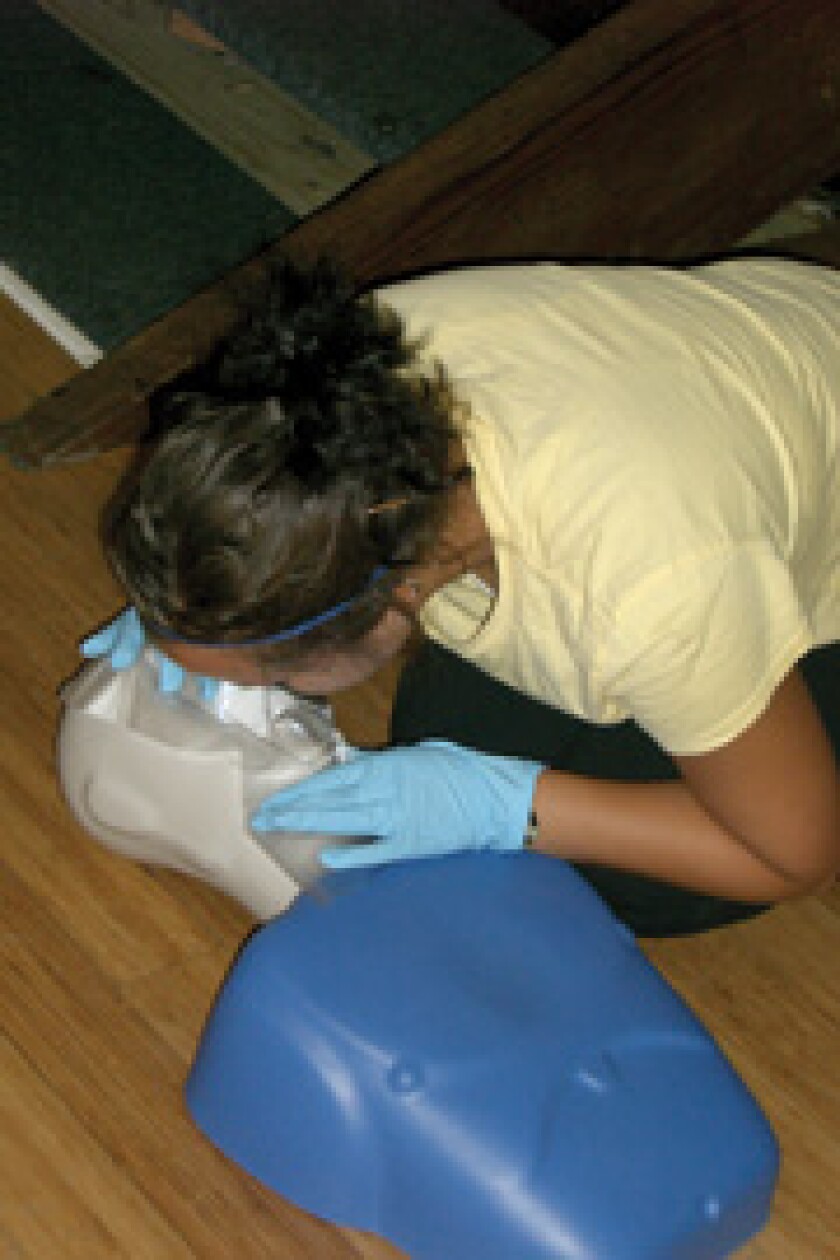
More than 2,000 students at Cal receive basic supplies, like a generator, goggles, fire extinguisher, portable lights and two-way radios. A total of six equipment caches were obtained through an $18,000 grant that Dong applied for and received. The students also receive training in at least some of the following courses: basic preparedness, fire suppression, light search and rescue, disaster first aid, disaster mental health, radio communications and incident command systems.
Besides filling a critical public safety need, it's also an opportunity to fortify the public image of the campus's Greek system, Kerr said.
"The chapters are required to attend training, but we usually get more numbers than that because the things we're teaching people - fire suppression, emergency first aid, triage, light search and rescue - are good life skills that a lot of people are interested to learn. They just didn't have an outlet through which they could help; they didn't know how to help," he said. "So we're saying, 'Look, in case something goes wrong, here's how you can help; here's how you can be prepared; here's how you can make things better.' We're giving them a lot of power to take control of things. They're very responsive."
The courses are taught through the Berkeley Fire Department, said Jennifer Heller, communications coordinator of the Berkeley Student Cooperative.
"Students take the courses for their own edification, and for the greater good of their fellow co-opers," she said. They don't earn credits toward a
college degree, but that could be offered someday, Dong said.
One person doesn't take all courses, Heller said. "By having different students take different courses, we are forming teams of co-opers that are trained in various areas to support their fellow members during an emergency," she said. "Our goal is that every co-op has a trained team of co-opers in case of emergency to provide any necessary support."
The class a student takes may be based on his or her major. For instance, an engineering student may be most interested in the "light search and rescue" class because it teaches how to use mechanical advantage, like taking plywood boards or long beams to help lift coffee tables or bookcases off someone, or how to brace up a building that's partially collapsed. "We take a premed student and say, 'You're perfect for disaster first aid,' Dong said, "Because they're interested in treating people anyway. Those are some of the selling points we offer to the students and how we recruit those who have to take it."
Kerr said the most important course he took was light search and rescue because after an earthquake, many people don't take a building's structural integrity into consideration. Even if a building appears to be intact, it could be a hazard because of unseen damage in the foundation and frame.
"You have to look around to determine whether it actually is safe, and while you may want to rush in and get someone out from the pile of rubble, you really have to make sure you take your own safety into consideration," Kerr said. "In the light search and rescue training, you definitely learn that 'slow is pro' - you have to do things in a timely manner, but you want to make sure you're doing them safely and appropriately. It really teaches you proper techniques."
Beginnings
Several groups collaborated as the idea took shape, including: the Center for Student Leadership, which oversees all the fraternities, sororities and multicultural student organizations; the Berkeley Student Cooperative; members from city departments, like the city manager's office, the Berkeley Fire Department, the OES; City Councilman Gordon Wozniak's office; the American Red Cross, Berkeley Campus Chapter; the IFC; and the Panhellenic Council.
They held monthly meetings to forge how they would implement the grant," Dong said. First they toured the student housing areas and identified key sites.
Stakeholders pushed back initially because of concerns about liability and responsibility, Dong said. Some of them asked if the proposed program would require that the student responders care for the whole neighborhood. "So we created a level of understanding for all participants to sign and pledge their participation," Dong said, "and we changed the IFC and Panhellenic social codes that govern them on how they're supposed to act - what things they're supposed to participate in to be organized student groups affiliated with [Cal]."
One IFC and Panhellenic social code that changed is that every individual must take a basic preparedness course. How the students take
this course is up to them. They can take a traditional 35- to 45-minute course taught by the Berkeley Fire Department or do it remotely via a podcast. The podcast is available through the Berkeley chapter of the American Red Cross, with whom the Berkeley Fire Department joined forces because the two had common goals.
The Red Cross wanted to train 1 million people in the Bay Area this year, Dong said. "And we said, 'We can be part of this process, so whoever we train, we'll give you their names.'"
Students can download the 20-minute podcast and take the test online. After taking the test, that information is submitted to the Red Cross, Dong said. Though the traditional course lets students ask questions directly, the podcast is an option to get students who are already doing homework and extracurricular functions involved.
The Collaborative Advantage
"You have to have a collaborative approach whenever you do something new or mandate something of somebody," Dong said.
Kerr also made note of the effective collaboration. "One of the coolest parts about this disaster-preparedness program is the cooperation that happened between the fire department, the university and the Cal fraternities and sororities," he said. "I just think it's one of the prime examples of greater involvement in the outside community for the fraternities and sororities in a very positive, beneficial, synergistic way."
It's important to recognize that the collaborative approach begins with the individual. Being prepared, Dong said, starts with the "me," and each individual in the community who's prepared alleviates responders' burden.
"If you're not prepared and you get injured, then you as an individual are going to need help from someone else, and we don't have the resources to do that," he said. "Everyone thinks the fire department will be there in four and a half minutes, but if we have a large-scale earthquake with multiple fires, with gas leaks, and we have an old infrastructure that needs to be retrofitted, Berkeley Fire Department resources will be nil until we get mutual aid."
And that's only if the roads are accessible, Dong said, noting that in the Bay Area, some surface streets and freeways could be blocked during an earthquake.
"If one takes care of himself or herself, that's one person we don't have to provide rescue, food, water or shelter for," he said. "And if we get one person to educate their community block, then the community block or neighborhood organization takes care of themselves."
This is the idea in training and equipping student organizations.
"Can you imagine if you gave me the Cal football team to rescue people with their size, their stamina? Because then I can take 10 firefighters and create 10 groups, and divide up the soccer, football, volleyball players or whoever, into 10 larger response groups," Dong said. "It only takes one firefighter to direct a group of people. They expand our first responder resources within our community. If I can get that entire student population prepared, they become the best volunteers for me."






